Quickly Master Complex Engineering Concepts
Whether you’re just starting out on your engineering journey or are an experienced professional, our aim is to provide you with all the resources you need to master tricky engineering concepts.
Step 1 – Learn
Learn the fundamentals of mechanical and civil engineering with the help of our articles and videos

Step 2 – Test
Check your understanding of different engineering topics using our detailed quizzes

Step 3 – Improve
Use resources like our summary sheets to continually develop and improve your knowledge
Not sure where to start? Here are a few featured topics that cover a range of interesting engineering concepts.

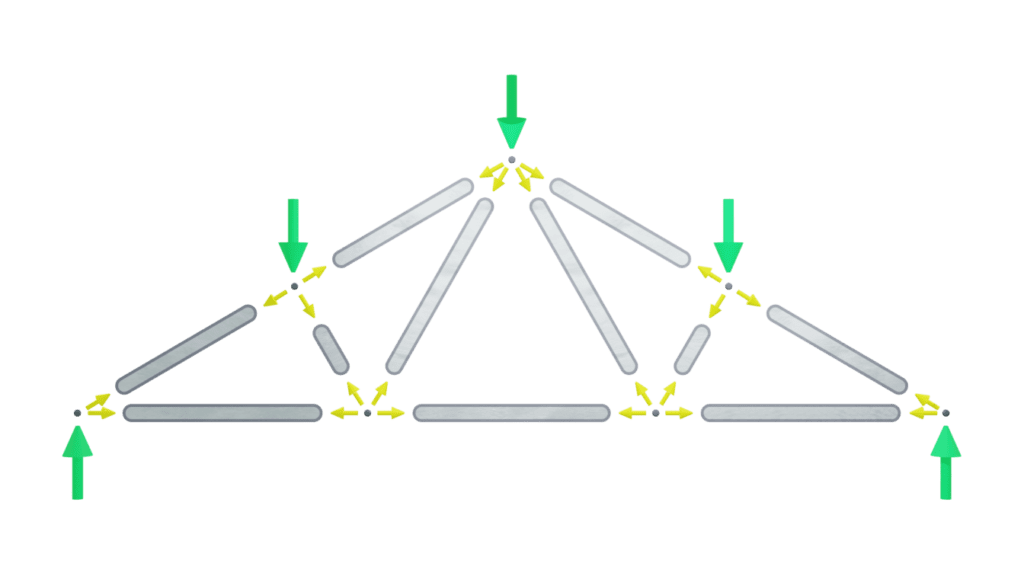
Trusses
Trusses are structures (e.g bridges or roofs) made up of members that can only carry tensile or compressive axial loads.

Buckling
Buckling is a sudden deflection that occurs in slender columns or members that are loaded in compression.

The Finite Element Method
The finite element method is a numerical method used to approximate the solution to complex problems governed by differential equations.

Thermal Radiation
Radiation is the heat transfer mode where an object emits energy in the form of electromagnetic radiation due to its temperature.
The Efficient Engineer summary sheets are designed to present all of the key information you need to know about a particular engineering topic on a single page. It doesn’t get more efficient than that!
You can use them as study aids, or just as handy references guides for whenever you need to brush up on a troublesome topic.

Watch the latest video from the Efficient Engineer YouTube channel.
The Incredible Properties of Composite Materials
The latest Efficient Engineer video covers composite materials.
This video explores the different types of composites, and how their use to create materials with incredible properties has completely transformed how some of the most advanced enginering problems can be solved.
Test your understanding of engineering concepts with the question of the day.
The bending moment diagram for a beam is shown below.
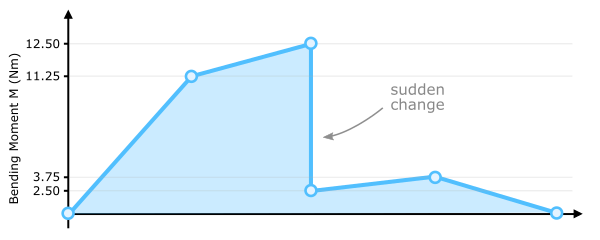
What is the cause of the sudden change in bending moment?
A moment acting at that location
A moment acting elsewhere on the beam
A concentrated load at that location
A uniformly distributed load covering that section of the beam
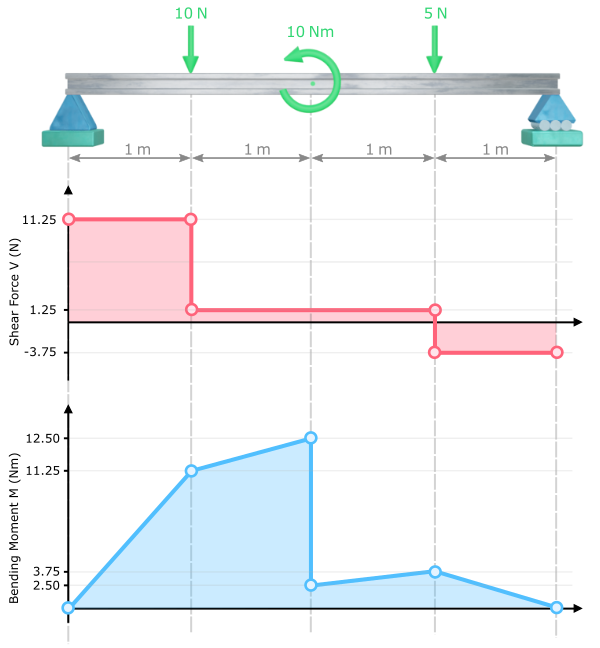
A moment acting at a point will cause a sudden change in the bending moment diagram at that point as the internal moment must change to balance the externally applied moment and keep the beam in equilibrium. The shear force profile is unaffected by any externally applied moments.
The beam configuration that would result in this bending moment profile is shown below.